
What Makes Antique Crystal Chandeliers So Special?
Few lighting fixtures command attention the way an antique crystal chandelier does. Once illuminated, it transforms a room, much like antiques chandeliers crystal. Light travels through layered crystal prisms, reflects against walls and ceilings, and creates a dimensional glow that modern fixtures rarely reproduce. It is not just lighting. It is architecture suspended in air.
An antique brass crystal chandelier carries more than ornamentation. Its solid brass frame develops a natural patina over decades, producing warmth that cannot be artificially aged with chemical finishes. The structure feels intentional and balanced. Each arm, crystal drop, and central column is engineered to distribute both weight and light with precision.
A vintage crystal chandelier value, while often younger than a true antique, reflects the design language of its period. Whether Victorian, French Empire, or early 20th-century European, these fixtures demonstrate craftsmanship that predates mass automation. Subtle irregularities in crystal cuts and metalwork reveal the human hand behind the piece.
Understanding what makes antique crystal chandeliers special requires looking beyond appearance. Their age, materials, and construction standards are what give them enduring value. Modern interpretations inspired by these historical forms can be explored within our premium chandeliers collection.
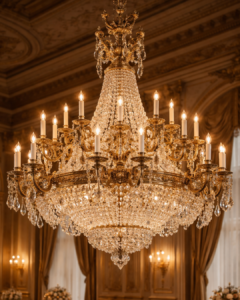
What Is a Crystal Antique Chandelier?
A crystal antique chandeliers is a lighting fixture typically over 100 years old, constructed using solid brass, hand-formed glass elements, and hand-cut chandelier crystals. Unlike modern factory-produced lighting, these chandeliers were built using traditional metalworking and crystal-cutting techniques that prioritized durability and balance.
For contemporary spaces seeking a similar aesthetic presence, a carefully crafted crystal chandelier can provide comparable visual brilliance while meeting modern electrical standards.
Age and Historical Significance
A chandelier is generally classified as antique once it surpasses the 100-year mark. Many authentic examples date back to the 18th and 19th centuries when chandeliers symbolized wealth, refinement, and architectural grandeur.This long history also plays a major role in determining the antique brass chandelier value, as age, craftsmanship, and originality often influence its worth.
These fixtures were often custom-made for estates, formal dining halls, opera houses, and boutique hotels. Their scale was carefully calculated to complement high ceilings and expansive interiors. In these environments, lighting was not secondary. It was central to the room’s design.
While a vintage brass and crystal chandelier may represent design movements from the early 1900s, a true antique piece reflects pre-industrial craftsmanship. That distinction carries both historical and structural significance.
Why Antique Crystal Chandeliers Continue to Hold Their Value
Collectors and interior designers continue to appreciate antique crystal chandeliers because they combine historical craftsmanship with long-term durability. The vintage crystal chandelier value often increases when the fixture retains its original brass framework and hand-cut crystal prisms. Unlike mass-produced lighting, authentic antique pieces reflect generations of skilled craftsmanship and timeless European design. Businesses looking for premium manufacturing standards can also explore our Crystal Chandelier Manufacturer for custom luxury lighting solutions.
Materials Used in Antique Crystal Chandeliers
Material integrity is one of the clearest indicators of authenticity.
Solid Brass Construction
An antique brass and crystal chandelier was typically constructed using heavy, solid brass. Unlike modern plated alternatives, solid brass develops a natural oxidation layer over time. This patina is not damage. It is a sign of age and material authenticity.
Brass was chosen not only for aesthetics but for structural strength. Large chandeliers require stable frames to support the weight of multiple crystal arms and drops. Many modern premium designs, including select luxury crystal chandeliers, continue to use strong metal frameworks inspired by historical engineering standards.
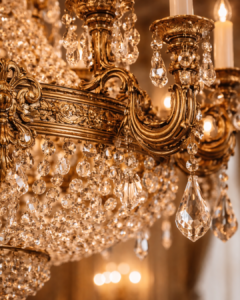
High-Lead Crystal Prisms
True antique chandeliers feature dense, high-lead chandelier crystals. These prisms are heavier than molded glass and offer superior light refraction.
When illuminated, crystal components bend light into subtle spectral reflections, creating layered brilliance rather than simple brightness. This optical quality is one reason collectors and designers value antique crystal lighting.
The term chandelier crystal antique often refers to these original hand-cut prisms, which differ significantly from modern machine-produced replacements.
Glass Arms and Decorative Elements
Some antique brown glass chandelier designs incorporate hand-formed glass arms, bobeches, and central stems. These components were shaped individually, resulting in slight variations that confirm manual production.
Unlike uniform factory molds, small inconsistencies are often indicators of authenticity rather than flaws.
Many luxury hospitality projects combine antique-inspired lighting with modern production standards to achieve timeless elegance. If you’re planning a hotel, villa, or luxury residence, explore our Modern Chandelier Manufacturer for premium custom lighting solutions:
Craftsmanship and Structural Engineering
The most defining characteristic of an antique crystal chandelier is craftsmanship.
Each arm was shaped using traditional metalworking methods. The curvature was deliberate, designed to support crystal weight while maintaining visual symmetry. Wiring was originally integrated for candle use or early electrification systems, later adapted to modern standards during restoration.
Balance was essential. A large chandelier cannot rely on decoration alone. Its central column must distribute weight evenly to prevent structural stress. This level of mechanical consideration required hands-on expertise long before digital design tools existed.
Whether examining an antique brass crystal chandelier or a refined vintage crystal chandelier, the engineering behind the fixture is as important as its ornamentation.
The Importance of Hand-Cut Chandelier Crystals
One of the clearest distinctions between antique and modern fixtures lies in the crystals themselves.
Hand-cut chandelier crystals typically feature:
- Sharper edge definition
- Slight dimensional variation
- Greater weight per piece
- Superior light dispersion
Machine-molded glass may appear similar from a distance, but it lacks the density and optical clarity of traditional crystal cutting techniques.
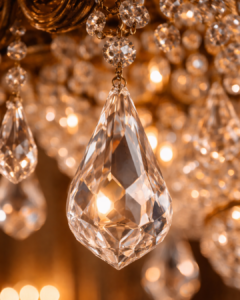
Antique vs Vintage Crystal Chandeliers: What’s the Difference?
An antique brass and crystal chandelier light is generally over 100 years old. These fixtures were produced before modern industrial automation became standard. Their construction reflects traditional metal casting, manual assembly, and hand-cut crystal detailing. Age is not simply a number; it signals a specific production era and material quality that predates factory standardization.
A vintage brass and crystal chandelier typically ranges between 20 and 99 years old. These pieces reflect design movements of the late 19th and 20th centuries. For those seeking custom period-inspired pieces for projects or hospitality spaces, tailored production is available through our OEM lighting services.
Key Differences at a Glance
| Feature | Antique Crystal Chandelier | Vintage Crystal Chandelier |
| Age | 100+ years old | 20–99 years old |
| Historical Era | Pre-industrial or early industrial craftsmanship | 20th-century design movements |
| Materials | Solid brass, high-lead crystal, hand-formed glass | Brass, crystal, sometimes early machine-cut elements |
| Production Method | Primarily handcrafted | Blend of handcrafted and early mechanization |
| Collector Demand | Higher rarity value | Strong design appeal and usability |
While both categories can feature solid brass frames and crystal detailing, an antique piece often reveals deeper signs of manual workmanship. Slight asymmetries in casting, heavier metal components, and earlier wiring adaptations are common indicators.
A vintage crystal chandelier may appear more uniform due to improved tooling in the early industrial period. That uniformity does not reduce its value. Many vintage designs are highly sought after for their transitional style and proportional balance.
The core difference ultimately rests in age, historical production methods, and the level of handcrafting involved.
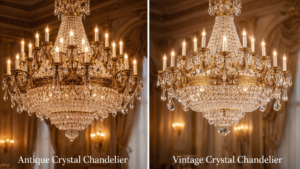
The Craftsmanship Behind Antique Chandeliers
The defining quality of an antique crystal chandelier lies in how it was built. Materials alone do not determine authenticity. It is the integration of metalwork, crystal cutting, and structural engineering that sets these fixtures apart.
Hand-Cut Crystal Prisms
Original antique chandeliers feature hand-cut crystal prisms shaped individually by skilled craftsmen. Each piece was faceted, polished, and drilled manually before assembly.
True chandelier crystal antique components typically display:
- Sharp edge clarity
- Slight dimensional variation
- Noticeable weight
- Superior optical refraction
Unlike molded glass, hand-cut crystal refracts light in multiple directions. When illuminated, it produces layered brilliance rather than a single flat glow. This interaction between light and crystal is one of the defining characteristics of antique lighting.
Solid Brass Frames
An authentic antique brass and crystal chandelier commonly features a frame constructed from cast solid brass. This metal was chosen for both durability and workability.
Traditional brass casting methods produced dense structural components capable of supporting multiple tiers of crystal arms and droplets. Over time, brass naturally oxidizes, forming a warm patina. This aging process enhances visual depth and cannot be artificially replicated with modern surface treatments.
Proper weight distribution was essential. The central column had to carry the load evenly while maintaining symmetry across all arms. This required mechanical precision long before digital modeling tools existed.
Glass Arms and Decorative Elements
Many antique designs incorporate hand-formed glass arms and decorative stems. An antique glass chandelier may reveal slight differences in curvature or thickness across arms. These subtle variations are not flaws. They are evidence of manual shaping and finishing.
Glass bobeches, collars, and central stems were fitted carefully to align both visually and structurally. Each component contributed to the chandelier’s balance.
European Design Influence
European workshops heavily influenced antique chandelier construction. French Empire designs emphasized symmetry and grandeur. Bohemian crystal producers advanced lead-content cutting techniques to increase light dispersion. Italian glassmakers refined arm shaping and decorative detailing.
These regional traditions shaped the identity of the antique brass and crystal chandelier as both a lighting instrument and an architectural feature.
The craftsmanship behind antique chandeliers reflects a production era where lighting was engineered for permanence. Every crystal prism, brass arm, and glass component was assembled with intention. That integration of structure, material, and optical performance is what continues to distinguish antique crystal chandeliers today.
Why Antique Brass Crystal Chandeliers Are Highly Valed
An antique brass crystal chandelier is prized not simply because it is old, but because of how it was built. Material integrity, structural engineering, and long-term durability are what distinguish these fixtures from decorative reproductions, making them stand out among old crystal chandeliers.
Brass was historically selected for its strength, corrosion resistance, and ability to be cast into detailed forms. In authentic antique chandeliers, the frame is typically solid cast brass rather than thin plated steel or alloy.
Real Brass vs Plated Metal
Solid brass has noticeable weight and density. When lifted or handled, it feels balanced and substantial. Plated metal, by contrast, is often lighter and may reveal a base material beneath if scratched.
In a genuine antique brass and crystal chandelier, brass is not surface decoration. It forms the internal structure that supports the arms, central stem, and multiple tiers of chandelier crystals. Early brass alloys often contained a higher copper content, contributing to strength and warm coloration.
Collectors and restoration specialists commonly examine:
- Interior joints
- Underside of arms
- Fastening hardware
- Casting seams
Consistent metal density and traditional fastening methods are strong indicators of authenticity.
Patina Development
One of the defining characteristics of antique brass is its natural patina. Over decades, exposure to air and handling creates gradual oxidation. This produces a softened tone with subtle darkening in recessed areas and gentle highlights along exposed edges.
Patina cannot be convincingly rushed. Artificial aging techniques tend to appear uniform or overly dark. Natural patina develops unevenly, reflecting environmental exposure and use history.
For many buyers, this aged finish enhances authenticity. It communicates longevity rather than surface polish.
Durability and Structural Engineering
Brass resists rust and maintains structural stability over long periods. When an antique brass crystal chandelier is properly restored and rewired to modern safety standards, it can remain functional for generations.
Original fabrication required careful weight distribution. The central column had to carry the outward extension of multiple arms, along with the combined weight of dense crystal prisms. Without balanced engineering, sagging or warping would occur.
This attention to structural integrity is one reason antique chandeliers survive well over a century.
Investment and Collector Value
Beyond craftsmanship, antique brass chandeliers carry investment appeal. Supply is finite. Authentic examples cannot be newly produced in their original historical context.
Value is influenced by:
- Condition
- Original crystal retention
- Structural integrity
- Provenance
- Period design
An authentic antique brass crystal chandelier with original hand-cut crystals and intact brass framework often retains strong resale interest. Restoration can preserve value when original materials are respected.
Age alone does not determine worth. Craftsmanship and originality remain central.
The Role of Chandelier Crystals in Luxury Appeal
While brass provides the framework, chandelier crystals create the visual drama. The way light interacts with crystal elements determines the chandelier’s overall presence.
Refraction and Optical Performance
Crystal differs from standard glass in composition and density. High-lead crystal, commonly used in historical chandeliers, contains lead oxide that increases its refractive index.
When light passes through crystal, it bends and separates into subtle spectral tones. This process, known as refraction, produces layered brilliance rather than a single flat beam.
Each prism functions like a small lens. As light shifts, reflections move across surrounding surfaces.
Light Dispersion and Spatial Depth
Well-cut chandelier crystals disperse light outward through multiple angled facets. Instead of directing brightness in one direction, they scatter reflections throughout the room.
This dispersion creates depth. Ceilings, walls, and architectural details catch secondary reflections, producing a dimensional glow.
The brilliance associated with antique crystal chandeliers comes from this controlled interaction between cut angle, crystal density, and light source.
Hand-Cut vs Machine-Cut Crystals
Original antique chandeliers typically feature hand-cut crystal prisms. These pieces were shaped, faceted, and polished individually.
Characteristics of hand-cut crystals include:
- Slight dimensional variation
- Deeper, sharper facets
- Greater weight per piece
- Enhanced light refraction
Machine-cut crystals are more uniform. While modern technology can achieve clarity, historical hand-cut methods often used higher lead content, increasing optical performance.
In many antique fixtures, the presence of original hand-cut crystals significantly influences value.
Crystal vs Glass: Understanding the Difference
Although crystal and glass may appear similar at a distance, they differ in density and brilliance.
Crystal:
- Heavier
- Higher refractive index
- Produces layered sparkle
Standard glass:
- Lighter
- Lower refraction
- Produces flatter illumination
An antique chandelier fitted with genuine crystal prisms displays dynamic reflection patterns under direct light. The sparkle extends beyond surface shine, creating movement and depth within the space.
How to Identify an Authentic Antique Crystal Chandelier
Determining whether a chandelier is truly antique requires careful evaluation. Age alone is not enough. Material composition, construction methods, and visible wear patterns all provide evidence of authenticity. While formal appraisal may be required for high-value acquisitions, several physical indicators can help confirm whether a piece is genuinely antique.
Key Signs of an Authentic Antique Crystal Chandelier
Weight and Density
Authentic antique chandeliers are typically substantial in weight. Solid brass frames and high-lead chandelier crystals add noticeable density. When lifted or handled, a genuine fixture feels balanced and structurally grounded.
If a chandelier appears unusually light for its size, it may contain hollow metal components or plated alloys rather than solid brass construction.
Natural Brass Oxidation
Original antique brass develops patina gradually over decades. This oxidation produces subtle darkening in recessed areas and soft highlights along edges exposed to touch.
Artificial finishes tend to look uniform or overly polished. Natural patina forms unevenly and reflects environmental exposure over time.
A genuine antique brass crystal chandelier often shows layered tonal variation rather than a single surface color.
Hand-Cut Crystal Variations
Antique chandelier crystals were shaped and polished individually. Slight differences in facet depth, drilling alignment, or prism size are common. These minor irregularities indicate manual production.
Uniform, perfectly identical prisms are more typical of modern machine-cut manufacturing.
Original Candle Arms or Early Electrical Conversions
Many antique chandeliers were originally designed for candles before being adapted for early electrical systems. Look for wax pans, candle sleeves, or signs of historic wiring updates.
Evidence of conversion rather than modern factory wiring can support authenticity.
Traditional Fastening Methods
Older fixtures commonly use threaded rods, nuts, and mechanically joined arms rather than welded joints. Visible hardware consistent with historical manufacturing methods is another sign of age.
Authenticity is rarely confirmed by a single detail. It is the combination of weight, metal condition, crystal workmanship, and construction technique that establishes credibility.
Antique Crystal Chandeliers in Modern Luxury Interiors
Today, antique crystal chandeliers are no longer limited to heritage buildings. Luxury homes, boutique hotels, restaurants, and commercial projects frequently combine antique-inspired lighting with modern engineering to create elegant interiors. Businesses looking for custom manufacturing services can explore our Chandelier Lighting Manufacturer in China:
For hospitality projects requiring large decorative fixtures, our Wholesale Chandelier Supplier for Hotels offers customized chandelier solutions for hotels, resorts, villas, and commercial developments:
Frequently Asked Questions
Why are antique crystal chandeliers expensive?
Antique crystal chandeliers are expensive due to limited supply, material quality, and historical craftsmanship. Solid brass frameworks and original hand-cut chandelier crystals increase both aesthetic and collector value. Rarity and condition significantly influence pricing.
How can I tell if chandelier crystals are real?
Real chandelier crystals are heavier than standard glass and produce stronger light refraction. When exposed to direct light, genuine crystals create layered reflections rather than flat glare. Small hand-cut variations are common in authentic antique pieces.
What is the difference between antique brass and modern brass?
Antique brass typically features solid cast construction and natural patina developed over decades. Modern brass may be plated over steel or alloy and often has a uniform surface finish. Natural oxidation patterns help distinguish older brass from contemporary materials.
Are antique glass chandeliers still safe to use?
An antique glass chandelier can remain safe when properly restored and rewired according to current electrical standards. Original wiring is often outdated and should be professionally updated before installation.
Can chandelier crystals be replaced?
Yes, chandelier crystals can be replaced. However, replacing original hand-cut prisms may affect collector value. When restoration is necessary, matching weight, cut, and clarity helps preserve visual balance and authenticity, including considerations for what to do with old chandelier crystals and used crystal chandeliers.
How much is a crystal chandelier worth?
The value of a crystal chandelier can vary widely depending on factors such as size, material quality, brand, craftsmanship, and design complexity. Basic models may start from a few hundred dollars, while high-end or custom-designed chandeliers can cost several thousand dollars or more.
How do I identify the value of an antique crystal chandelier?
The value depends on factors such as age, original crystal condition, brass quality, craftsmanship, rarity, historical significance, and whether the chandelier has been professionally restored.
Are vintage crystal chandeliers a good investment?
Yes. Authentic vintage crystal chandeliers are highly valued for their craftsmanship, timeless design, and collector appeal. Well-maintained pieces often retain or increase their value over time.
Conclusion
An authentic antique brass crystal chandelier represents more than decoration. It reflects craftsmanship, structural engineering, and historical design standards that have endured for generations. Solid brass frameworks, hand-cut chandelier crystals, and traditional assembly methods define its lasting appeal.
These fixtures continue to bring architectural depth and visual proportion to heritage properties, luxury residences, and refined interiors. Their presence combines material integrity with optical brilliance.